
New NCERT Solutions for Chapter 4 Vitamin-M Class 9 English Poorvi
- Chapter Name: Vitamin-M
- Textbook Name: Class 9 English Kaveri
- Related Stud material: Class 9 Kaveri NCERT Solutions
Chapter 4 Vitamin-M NCERT Solutions Class 9 English
Page No. 97
Reflect and Respond
I. From your experience with an elderly person at home or in your neighbourhood, complete the following graphic organiser.
Now, discuss the points written in the organiser with your classmates and teacher.
Answer
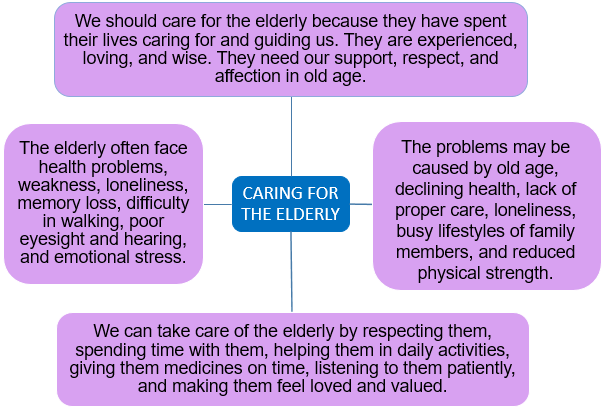
II. Fill in the table given below. You may check your answers with the help of a dictionary.

Answer
| Word | Not heard this word before | Have heard this word but don’t know what it means | I know this word. It has something to do with… | Write the meaning of this word |
|---|---|---|---|---|
| 1. frail | weakness or old age | weak and delicate | ||
| 2. shuddered | fear or shock | trembled because of fear or disgust | ||
| 3. poky | small space | small, cramped, and uncomfortable | ||
| 4. forbid | stopping someone | to not allow someone to do something | ||
| 5. pottering | doing small activities | doing small tasks in a relaxed way | ||
| 6. winced | pain or embarrassment | showed discomfort or embarrassment on the face |
III. Think of a tradition, story, or recipe passed down by grandparents or an elderly relative in your family. What does it mean to you? How does it connect you to your growing-up years? Share with your classmates and teacher.
Answer
One special tradition passed down by my grandmother is making homemade pickles during the summer season. Every year, she carefully prepared mango pickles using traditional spices and methods. As a child, I loved helping her dry the mango pieces in the sunlight and mix the spices together.
This tradition means a lot to me because it reminds me of the happy moments I spent with my grandmother. It connects me to my childhood memories, family values, and our cultural traditions. While working with her, I learned patience, teamwork, and the importance of preserving family customs.
Even today, whenever I taste homemade pickle, I remember those joyful days spent with my grandmother. It makes me feel close to her and keeps our family tradition alive.
Page No. 102
Check Your Understanding
I. Why did Grandpa dislike living in the city with his daughter?
II. Why did Vidya not want her father to go out alone?
III. Was Ravi in favour of his mother treating Grandpa like a child? How can you say so?
IV. Would Ravi be able to keep up his promise to his mother?
Answer
I. Grandpa disliked living in the city because he hated the noise, crowd, and busy lifestyle of the city. He missed his peaceful brick house in the town where there was a big mango tree and complete silence in the evenings.
II. Vidya did not want her father to go out alone because he had become forgetful and weak due to old age. Earlier, he had accidentally taken a double dose of medicines and had once lost his way while returning from a walk. She feared for his safety.
III. No, Ravi was not in favour of his mother treating Grandpa like a child. Ravi felt uncomfortable when his mother spoke loudly to Grandpa as if he could not understand properly. He respected his grandfather and believed that he should be treated with dignity.
IV. Ravi tried his best to keep his promise to his mother. Although he allowed Grandpa to go out alone, he secretly followed him throughout the day to ensure that he remained safe and did not face any danger.
Page No. 106
Check Your Understanding
5. Complete the flow chart by describing Grandpa’s day out.

Answer
1. children’s park
2. peanuts; children play
3. tea stall
4. the child’s mother and vendors
5. tea; bananas and ice cream
6. barber shop
7. bus stop; boards a bus
II. Was Grandpa lost as feared by Ravi’s mother?
Answer
No, Grandpa was not lost. In fact, he was clever and fully aware of his surroundings. He successfully returned home before Ravi and even managed to trick Ravi during the outing.
III. How would Ravi feel after seeing Grandpa?
Answer
Ravi felt extremely relieved, happy, and emotional after seeing Grandpa safely at home. He realized how much he loved and cared for his grandfather. He hugged him affectionately and understood that Grandpa was wiser and smarter than everyone thought.
IV. Do you think Ravi’s mother will get to know about what had happened?
Answer
It is possible that Ravi’s mother may not fully learn about the entire incident because neither Ravi nor Grandpa openly revealed the truth. However, Grandpa’s comments and gift hinted that he knew Ravi had followed him throughout the day.
Page No. 109
Check Your Understanding
I. Describe how Ravi’s emotional reaction upon finding Grandpa safe at home reveals his feelings towards his grandfather.
Answer
When Ravi found Grandpa safe at home, he felt deeply relieved and emotional. He hugged Grandpa lovingly and noticed every little detail about him. This reaction showed Ravi’s deep affection, concern, and respect for his grandfather. It also showed that Ravi genuinely cared about Grandpa’s safety and wellbeing.
II. What might be the significance of Grandpa’s habit of giving gifts to everyone on his birthday rather than receiving them?
Answer
Grandpa’s habit of giving gifts on his birthday shows his loving, generous, and caring nature. Instead of expecting gifts from others, he preferred making his family happy. This also highlights his emotional maturity and selflessness.
III. Why do you think Grandpa gave Ravi a detective story book as a gift? What might this suggest about Grandpa’s awareness of Ravi’s actions earlier in the day?
Answer
Grandpa gave Ravi a detective story book because he knew Ravi had secretly followed him like a detective throughout the day. Through the gift, Grandpa playfully hinted that he was aware of Ravi’s actions. It also showed Grandpa’s sense of humour and intelligence.
This suggests that Grandpa was fully aware that Ravi had been secretly following him throughout the day. By gifting Ravi a detective story book and mentioning how to avoid getting fooled while trailing a suspect, Grandpa playfully hinted that he had understood Ravi’s actions all along.
Page No. 109
Critical Reflection
I. Read the extracts given below and answer the questions that follow.
1. Grandpa hated the noise and bustle of city life and when they were on their own, he often spoke longingly of his small brick house in town. “Such a wonderful place…! With that big mango tree in the garden! It is so quiet that at dusk you can even hear a leaf fall!” But then Grandpa had slipped and fallen in the garden late one evening while he was pottering around and lain outside all night because there was no one at home to help him up.
(i) Choose the emotion displayed by the Grandfather.
A. regretful
B. apologetic
C. nostalgic
D. wistful
Answer
C. nostalgic
(ii) Complete the following sentence with a reason.
Grandpa hated the busy and noisy city life because _________.
Answer
Grandpa hated the busy and noisy city life because he loved the peace and quietness of his small town house.
(iii) Why did Grandpa come to the city despite his dislike for city life?
Answer
Grandpa came to the city because he had slipped and fallen in his garden one night and there was nobody to help him. His daughter became worried and brought him to live with her family for safety.
(iv) Choose an expression similar in meaning to ‘you can even hear a leaf fall’.
A. end of one’s life
B. arrival of autumn
C. sign of good luck
D. pin drop silence
Answer
D. pin drop silence
26. State one advantage and one disadvantage of the Grandfather living in the house in town.
Answer
Advantage: The house was peaceful and comfortable.
Disadvantage: There was nobody to help Grandpa during emergencies.
2. “I had a quiet morning, but I don’t know about Ravi. He just disappeared instead of staying at home to look after me like you told him to,” answered Grandpa coolly, while Ravi just looked confused and embarrassed.
Grandpa had another surprise for Ravi. A gift-wrapped parcel!
“But, Papa, Ravi’s birthday was three months ago. Have you forgotten?” exclaimed Ravi’s mother, impatiently.
(i) Choose the option that displays the tone of the Grandfather’s response.
A. apologetic
B. hurtful
C. calm
D. puzzled
Answer
C. calm
(ii) Why was Ravi confused and embarrassed?
Answer
Ravi was confused and embarrassed because Grandpa cleverly hinted that he knew Ravi had secretly followed him during the day.
(iii) Complete the sentence with a suitable reason.
Ravi’s mother was impatient because __________.
Answer
Ravi’s mother was impatient because she thought Grandpa had forgotten Ravi’s birthday.
(iv) State whether the following sentence is true or false.
Grandfather forgot that Ravi’s birthday was three months ago.
Answer
False
(v) Why did Grandpa say he didn’t know what kind of morning Ravi might have had?
Answer
Grandpa said this jokingly because Ravi had disappeared while secretly following him around the city.
II. Answer the following questions.
1. Grandpa is portrayed as a person with failing memory in the beginning of the story. Give two evidences to disprove the statement.
Answer
Two evidences that disprove the statement are:
- Grandpa remembered famous chess games and strategies in great detail.
- He remembered his birthday and his tradition of giving gifts to every family member.
2. Give two characteristic traits of each of the following characters.
(i) Grandfather
(ii) Ravi
(iii) Ravi’s mother
Answer
(i) Intelligent: Grandpa cleverly fooled Ravi during the bus incident and knew Ravi was following him.
Generous: He gave away his cap to a stranger and gifted presents to his family members on his birthday.
(ii) Caring: Ravi secretly followed Grandpa to ensure his safety.
Respectful: He respected Grandpa and disliked the way his mother treated him like a child.
(iii) Concerned: She constantly worried about Grandpa’s health and safety.
Protective: She did not allow Grandpa to go out alone because she feared he might get hurt or lost.
3. Why was Ravi worried about what Grandfather had at the tea stall?
Answer
Ravi was worried because Grandpa drank sugary tea and ate bananas and ice cream, which were restricted food items at home due to his health condition. Ravi feared these foods might affect Grandpa’s health.
4. Do you think it was easy for Ravi to follow his Grandfather? If yes, why? If no, why not?
Answer
No, it was not easy for Ravi to follow his grandfather. He faced many embarrassing and difficult situations while hiding behind bushes, trees, and vehicles. He was questioned and scolded by strangers and had to constantly run around to keep track of Grandpa.
5. ‘Ravi is a good detective’. Give one argument in favour of and against the given statement.
Answer
In favour: Ravi carefully followed Grandpa throughout the day to make sure he remained safe.
Against: Grandpa successfully fooled Ravi by giving his cap to another man, proving Ravi still lacked proper detective skills.
6. Was Grandfather aware that Ravi was following him? How do you know?
Answer
Yes, Grandfather was aware that Ravi was following him. This is clear from the detective story book he gifted Ravi and his humorous comment about learning how not to get fooled while trailing a suspect.
7. In your opinion, who needs Vitamin-M? And why?
Answer
In my opinion, Ravi’s mother needs Vitamin-M because she wrongly assumed that Grandpa had become forgetful and helpless. She forgot his intelligence, independence, and sharp memory. Grandpa proved that he was still clever and capable.
8. Some people believe society shows bias based on age (being young or old). Give an example where you might have experienced or observed such discrimination, when opinions were disregarded because of age.
Answer
I have seen elderly people being ignored during family discussions because others think they are too old to understand modern ideas. Similarly, children are sometimes not allowed to express opinions because adults think they are too young. Such behaviour shows age-based discrimination.
Page No. 111
Vocabulary and Structures in Context
I. Classify the words given in the box on the next page into movement words in Column 1 and sound words in Column 2. One example has been done for you.

Answer
| Column 1 (Movement Words) | Column 2 (Sound Words) |
|---|---|
| pottering | boomed |
| twirling | thudded |
| crouch | whirr |
| bustle | grunted |
| crawl | shrieks |
| creeping | snoring |
| ducked | |
| zigzagging | |
| evicted | |
| briskly | |
| jumping | |
| darted | |
| trailing | |
| sprinting |
Now, Fill in the blanks with appropriate words from Column 1 or Column 2.
Detective Shankar, 1. _________ the mysterious suspect through the dimly lit side lanes, away from the 2. _________ of the city, quickened his pace 3. _________. The suspect’s heavy footsteps 4. __________ across the street, unaware of the pursuit. Shankar 5. _________ his magnifying glass had to 6. _________ behind the market stalls, 7. _________ through the lanes to avoid being seen. Shankar 8. _________ when he hit himself against a pole. This alarmed the suspect and he 9. _________ into the night leaving only the distant 10. _________ of the sleeping city behind.
Answer
Detective Shankar, 1. trailing the mysterious suspect through the dimly lit side lanes, away from the 2. bustle of the city, quickened his pace 3. briskly. The suspect’s heavy footsteps 4. thudded across the street, unaware of the pursuit. Shankar 5. twirling his magnifying glass had to 6. crouch behind the market stalls, 7. creeping through the lanes to avoid being seen. Shankar 8. grunted when he hit himself against a pole. This alarmed the suspect and he went 9. sprinting into the night leaving only the distant 10. whirr of the sleeping city behind.
II. Study the highlighted word in the given sentence from the text and fill in the boxes with synonymous words. You may refer to a dictionary.
Off he went, twirling his walking stick jauntily, leaving Ravi in a dilemma.

Answer
1. QUANDARY
2. PREDICAMENT
III. Fill in the table given below. Check your answers with the help of a dictionary.

Answer
| Word | Meaning | Part of Speech | Synonym | Antonym |
|---|---|---|---|---|
| 1. craftily | in a clever and tricky way | Adverb | cunningly | honestly |
| 2. dilemma | a difficult situation or problem | Noun | predicament | solution |
| 3. furious | extremely angry | Adjective | angry | calm |
| 4. boomed | made a loud deep sound | Verb | roared | whispered |
| 5. humiliation | a feeling of shame or embarrassment | Noun | embarrassment | honour |
| 6. attire | clothing or dress | Noun | outfit | undress |
IV. Match the emotions/expressions in Column 1 with their meanings in Column 2. One meaning is extra.

Answer
| Column 1 Emotions/Expressions |
Column 2 Meanings |
|---|---|
| 1. embarrassed | (v) felt uncomfortable |
| 2. countered | (iv) reply to an argument |
| 3. flushed | (vi) became red in the face |
| 4. stricken | (i) affected severely by an unpleasant feeling |
| 5. gleam | (iii) expression of emotion |
Extra Meaning: (ii) to be confused
V. Read the highlighted words in the following phrases from the story. Now, revisit the story and underline the prepositions.
- I’ll just walk across to the corner shop…
- … he felt a shadow fall over him…
- …the vendors sitting under the tree…
- Ravi took position behind a big banyan…

Now, fill in the blanks with appropriate prepositions.
I walked (i) ________ (through, between, against) the village, crossed a bridge (ii) _______ (over, under, beside) a brook, and found a quiet garden (iii) ________ (among, near, across) a cottage. Sitting on a bench (iv) ______ (on, at, in) the garden, I enjoyed the peaceful surroundings. Later, I strolled (v) ______ (beside, through, along) a riverbank, exploring the forest and heading (vi) ________ (into, towards, beyond) the unknown.
Answer
I walked (i) through the village, crossed a bridge (ii) over a brook, and found a quiet garden (iii) near a cottage. Sitting on a bench (iv) in the garden, I enjoyed the peaceful surroundings. Later, I strolled (v) along a riverbank, exploring the forest and heading (vi) towards the unknown.
VI. Read the following dialogues from the story.
1. “Shall we play chess or watch the cricket match on TV, Grandpa?” asked Ravi.
2. “Who are you?” said the little boy’s mother.
3. “What did you both do today?” asked Ravi’s mother.
4. “Have you forgotten?” countered Grandpa.
5. A small child came up to him and asked, “Are you playing hide and seek?”
Now, choose the correct answer.
A. The words in the quotes are (i) _________ (exclamatory/interrogative) sentences.
B. Sentences 1, 4, and 5 are (ii) __________ (Wh-/Yes, No type) interrogative sentences.
C. Sentences 2 and 3 are (iii) _________ (Wh-/Yes, No type) interrogative sentences.
So, there are (iv) _______ (two/three) types of interrogative sentences.

Answer
A. The words in the quotes are (i) interrogative sentences.
B. Sentences 1, 4, and 5 are (ii) Yes/No type interrogative sentences.
C. Sentences 2 and 3 are (iii) Wh- type interrogative sentences.
So, there are (iv) two types of interrogative sentences.
D. Let us have a quick glance at a few guidelines to remind you of the changes while transforming from direct form of speech to indirect. You can ask your teacher for more inputs.

VII. Read the following conversation.
Arvind: Do you help in taking care of your grandparents at home?
Priya: Yes, I do. We take turns making sure they're alright. Do you have grandparents living with you?
Arvind: No. My parents and I visit my grandpa every weekend. How do you manage your grandparents’ medical needs?
Priya: We have a schedule for giving medications and visits to the doctor.
Now, complete the following sentences in reported speech.
Arvind asked Priya if she 1. ___________ for which Priya replied in the affirmative and said that they 2. ___________. Priya further asked Arvind 3. ___________ Arvind replied in the negative and said that 4. __________ every weekend. He further enquired 5. ____________. Priya responded by saying that they 6. ____________.
Answer
Arvind asked Priya if she 1. helped in taking care of her grandparents at home for which Priya replied in the affirmative and said that they 2. took turns making sure they were alright. Priya further asked Arvind 3. if he had grandparents living with him. Arvind replied in the negative and said that 4. his parents and he visited his grandpa every weekend every weekend. He further enquired 5. how they managed their grandparents’ medical needs. Priya responded by saying that they 6. had a schedule for giving medications and visits to the doctor.
Page No. 116
Listen and Respond
I. You will listen to a podcast on meditation. As you listen, complete the sentences with not more than three exact words that you hear. (Transcript for teacher on page 266)
1. Meditation is a form of yoga that usually refreshes the mind and helps with __________.
2. Meditation leads to a better health condition both __________.
3. Meditation also aids in lessening undesirable feelings and improving __________.
4. It is advised that we meditate every day so that it becomes a _________.
5. Meditating on a daily basis is beneficial in comfortably tackling _________.
Answer
1. Meditation is a form of yoga that usually refreshes the mind and helps with concentration.
2. Meditation leads to a better health condition both physically and mentally.
3. Meditation also aids in lessening undesirable feelings and improving mental health.
4. It is advised that we meditate every day so that it becomes a daily habit.
5. Meditating on a daily basis is beneficial in comfortably tackling stressful situations.
Page No. 119
Writing Task
I. As you read in the story, we have a lot to learn from our elderly. Based on the lessons learned from them, write an article for your school magazine on the topic ‘Our Inspiring Elderly’.
Organise the article in the manner given below.
Follow the steps given below to write an article about your skills and passions.
Write the title at the top and your name and grade below it.
- Paragraph 1: Give a brief introduction to the topic. Focus on the main idea, but do not give any details.
- Paragraph 2: Give details to support the main idea—how the elderly inspire. Include examples, facts, and quotations.
- Paragraph 3: Elaborate on how they overcame challenges and the inspiring impact on you.
- Paragraph 4: Conclude with a final comment on the topic and leave the reader with the most important ideas to think about.
Answer
Our Inspiring Elderly
By Your Name
Grade IX
The elderly people in our families and society are a great source of wisdom, experience, and inspiration. They have spent years learning valuable lessons about life and often guide younger generations with love and care. Their knowledge, patience, and strength make them truly special and admirable.
Our elderly inspire us in many ways. They teach us important values such as honesty, kindness, discipline, and hard work. Grandparents often share stories from their childhood that help us understand the importance of family traditions and cultural values. Many elderly people continue to stay positive and active despite their age. As the saying goes, “Old is gold.” Their life experiences become lessons for the younger generation. They inspire us through their wisdom, sacrifices, and unconditional love.
Many elderly people have faced difficult challenges in life such as illness, loneliness, financial struggles, and personal loss. Yet, they continue to remain strong and hopeful. Their courage teaches us how to face problems with patience and confidence. Personally, I have learned from my grandparents to stay calm during difficult situations and to value relationships more than material things. Their guidance has helped me become more caring, respectful, and responsible.
In conclusion, the elderly are the pillars of our families and society. They deserve our love, respect, and care. We should spend time with them, listen to their experiences, and learn from their wisdom. Their lives remind us that true strength lies in patience, kindness, and experience. By respecting and caring for our elderly, we make our society more loving and compassionate.
Page No. 119
Learning Beyond the Text
I. Revisit the story and choose the image that correctly displays Grandpa’s walking stick.

Answer

The story describes Grandpa’s walking stick as a shiny-black mahogany walking stick with a brass handle carved in the shape of an eagle’s head.
II. A picture is worth a thousand words!
Explore and revisit memories.
Collect a few memorable photographs of yourself and your family. Make a slide show. Mention the following:
- When and where was it clicked?
- Who are the people in the photograph?
- Why is it memorable for you?
Answer


